AI for marketing works best on production work: first drafts of content, product and ad images, SEO briefs, weekly reports and research summaries. People still choose the buyer and the angle, check facts and claims, and approve what goes live. In the EU, AI Act Article 50 applies since 2 August 2026. Start with one weekly job, one reviewer and one number, and judge it after 90 days.
Key takeaways
- Use: in 2025, 34.7% of EU companies that used AI used it for marketing or sales, the most common purpose in Eurostat’s survey.
- Good jobs for AI: first drafts, product and ad images, SEO briefs, weekly reports and research summaries.
- People keep: the buyer, the angle, the facts and claims, and the final approval before anything goes live.
- Labels: since 2 August 2026, you disclose deep fakes under AI Act Article 50(4), and AI tools mark their output as AI-made.
- Measurement: each AI job gets one number, its value before you start and a date to check it.
- Bottom line: pick one weekly marketing job, give it a brief and a reviewer, and judge it on one number after 90 days.
AI for marketing teams in 2026
AI for marketing means using AI tools for the production work of a marketing team: drafts, images, briefs, reports and research. People decide what to make and approve it. In 2025, 34.7% of EU companies that used AI used it for marketing or sales, the most common purpose in Eurostat’s survey of companies with 10 or more employees.
AI use in EU companies
Updated November 2026levercrew
Marketing or sales is the top use of AI in EU companies
Share of EU companies using AI that use it for each purpose, in 2025.
Base: EU companies with 10 or more employees that used at least one AI technology in 2025.
The next purposes were business administration at 31% and accounting and finance at 23.1%. Logistics came last, at 6.1%. Overall, Eurostat counted 19.95% of EU companies using at least one AI technology in 2025, 6.47 points more than in 2024. Large companies lead: 55.03% of large EU companies used AI, against 17% of small ones.
Spain sits close to the EU average. In 2025, 20.27% of Spanish companies with 10 or more employees used AI, and 29.47% of those used it for marketing or sales.
In HubSpot’s 2026 State of Marketing survey of more than 1,500 marketers, 86.4% said their team uses AI in at least a few marketing areas. For content creation, 42.5% use AI extensively and 38% use it occasionally.
This guide is for the marketing lead or owner of a small or mid-size company that sells to other businesses or online. Prospecting has its own guide: AI for sales and AI SDRs.
Marketing jobs AI does well
AI does well the marketing jobs that start from facts you already have and end in a draft a person can check. These are content drafts, product and ad images, SEO briefs, weekly reports, personalised versions of a message and research summaries. In each job, AI makes the first version and a person checks and finishes it.
We work this way at LeverCrew. For RNJ Transport, a road freight company in Lithuania, AI image models made 27 website photos in one documentary style. We also made 20 LinkedIn videos, 10 in English and 10 in Lithuanian. One of us reviewed every piece before the client approved it. This is how we make AI content for ads and sales: the buyer and the angle first, then the variants.
The table lists six marketing jobs, what AI does in each and the part a person keeps.
| Marketing job | What AI does | What a person keeps |
|---|---|---|
| Content drafts | First drafts of articles, emails, posts and product texts from a brief | The angle, the facts, the brand voice and the final edit |
| Product and ad images and video | Images, scenes and short videos made from your own product photos | A check that the product looks like the real one, and the choice of what to test |
| SEO briefs and page updates | Keyword lists, page outlines, titles and meta descriptions | The topics that bring buyers, and a check of every title and claim |
| Weekly reporting | Collects numbers from analytics, ads and the CRM, and writes a first summary | What the numbers mean and what the team does next |
| Personalised versions | Versions of an email or landing page for each segment or industry | Which segment gets which offer, and the rules for customer data |
| Market and customer research | Summaries of reviews, call notes, competitor pages and search questions | Which findings are true for your buyers, and what to do with them |
Marketing work that stays with people
People keep the decisions that need knowledge of your buyers and responsibility for what you publish. That means who the buyer is, why they buy, which angle to test, whether each claim is true and whether a piece goes live. AI drafts the options. A person who knows the market chooses one and approves it.
The review loop
Updated November 2026levercrew
Every AI draft passes a person before it goes live
One marketing job, every week
- Write the brief Buyer, angle and facts
- AI makes a draft Text, image or report
- A person checks it Facts, claims and brand
- You approve it Before anything goes live
- Measure one number Against its starting value
The next brief starts from the results
Google gives the same advice for search. Its guidance on generative AI content says to fact-check and review all AI-generated content for accuracy before you publish it. The review also covers titles, meta descriptions, structured data and image alt text. Google adds that using AI to make many pages without value for users can break its spam policy on scaled content abuse.
In HubSpot’s 2026 survey, 73.4% of marketers said they see AI working together with marketers. 62.7% said brands need more unique, human-centred content to compete with AI content.
Anyone can make generic AI content. It speaks to everyone, so it speaks to no buyer in particular. Before AI makes anything, we write the buyer, the reason to buy, the facts and 3 to 5 angles in a brief. After a piece goes live, we measure one number, and the next brief starts from what that number shows.
Customer data in AI marketing tools
Personalised emails, segments and reports use personal data, so the GDPR applies when you put customer data into an AI tool. Use company accounts with a data processing contract, give the tool only the data the job needs, and respect every objection to direct marketing, including objections to profiling.
When an AI tool provider processes personal data for you, it acts as a processor under GDPR Article 28. The article says you may use only processors that give sufficient guarantees. The processing needs a contract that states its subject, duration, nature and purpose, the type of data and the groups of people concerned. Check that the plan your team uses offers such terms.
Personalisation is often direct marketing. Under GDPR Article 21(2), people can object at any time to the use of their data for direct marketing, and that includes profiling for it. Under Article 21(3), once a person objects, you stop using their data for that purpose. Keep the list of objections where the AI tool reads its data.
Agree four rules in writing before anyone pastes customer data into an AI tool. Our AI training for commercial teams covers these rules on the team’s own tasks.
- Company accounts only, with the provider’s data processing terms in place.
- The smallest data set the job needs: segments and fields, not the whole CRM.
- No special categories of data under GDPR Article 9, such as health data, in marketing prompts.
- One owner for the list of objections, checked before each send.
AI content labels under the EU AI Act
Article 50 of the EU AI Act applies since 2 August 2026. For a marketing team, two rules matter most. AI tools must mark their output as AI-made in a machine-readable way, and you must disclose deep fakes. AI text on matters of public interest needs a disclosure too, unless a person reviewed it and someone holds editorial responsibility.
EU AI Act, Article 50
Updated November 2026levercrew
Article 50 applies since August; older AI tools have until December
Dates for AI content rules
- 1 Aug 2024 AI Act enters into force
- 10 Jun 2026 Code of practice for labels
- 2 Aug 2026 Article 50 applies
- 2 Dec 2026 Deadline for older AI tools
Not legal advice. The December date covers AI tools on the market before 2 August 2026. Check your own case with your lawyer.
The AI Act entered into force on 1 August 2024. Paragraph 50(2) puts the marking duty on the providers of AI tools. The AI Act Service Desk timeline gives providers whose tools were on the market before 2 August 2026 until 2 December 2026 to comply. Paragraph 50(4) puts the deep fake duty on you, the user. For clearly artistic, creative, satirical or fictional work, you only disclose that AI content exists, in a way that does not disturb the work.
The AI Act defines a deep fake as AI image, audio or video that resembles real people, objects, places, entities or events and could falsely seem authentic. An AI scene with a real product or a real face can meet that definition, so check those pieces with care. Paragraph 50(5) says the information must be clear and given at the latest at the first exposure.
On 10 June 2026, the European Commission published a voluntary code of practice on marking and labelling AI-generated content, with EU icons for labels. Shops have one more rule. Google asks that AI-generated images in Merchant Center carry IPTC DigitalSourceType TrainedAlgorithmicMedia metadata, and that AI-generated product titles and descriptions be labelled as AI-generated. This guide is not legal advice, so check your own case with your lawyer.
First 90 days of AI in marketing
Spend the first 90 days on one marketing job your team does every week, such as the weekly report, product texts or ad variants. Write the brief, give the job one reviewer, record its number before you start and compare after 90 days. Add a second job only when the first one runs the same way every week.
Days 1 to 30. Choose the job and record how the team does it today and how many hours it takes. Record the starting value of the one number. Write a brief a new colleague could follow: the buyer, the facts, the voice and what a good result looks like. Run the first drafts with a person checking every one.
Days 31 to 60. Run the job every week. Each time the reviewer fixes something, add the fix to the brief or the prompt, so the next draft starts better. Save the brief, the prompts and the checks in a folder the team owns.
Days 61 to 90. Compare the number with its starting value, and the hours spent with the hours before. If the job runs the same way every week, make it a repeatable workflow and choose the second job. If it does not, fix the brief before you add more AI. We build AI workflows on the tools you already have when your team wants help with this step.
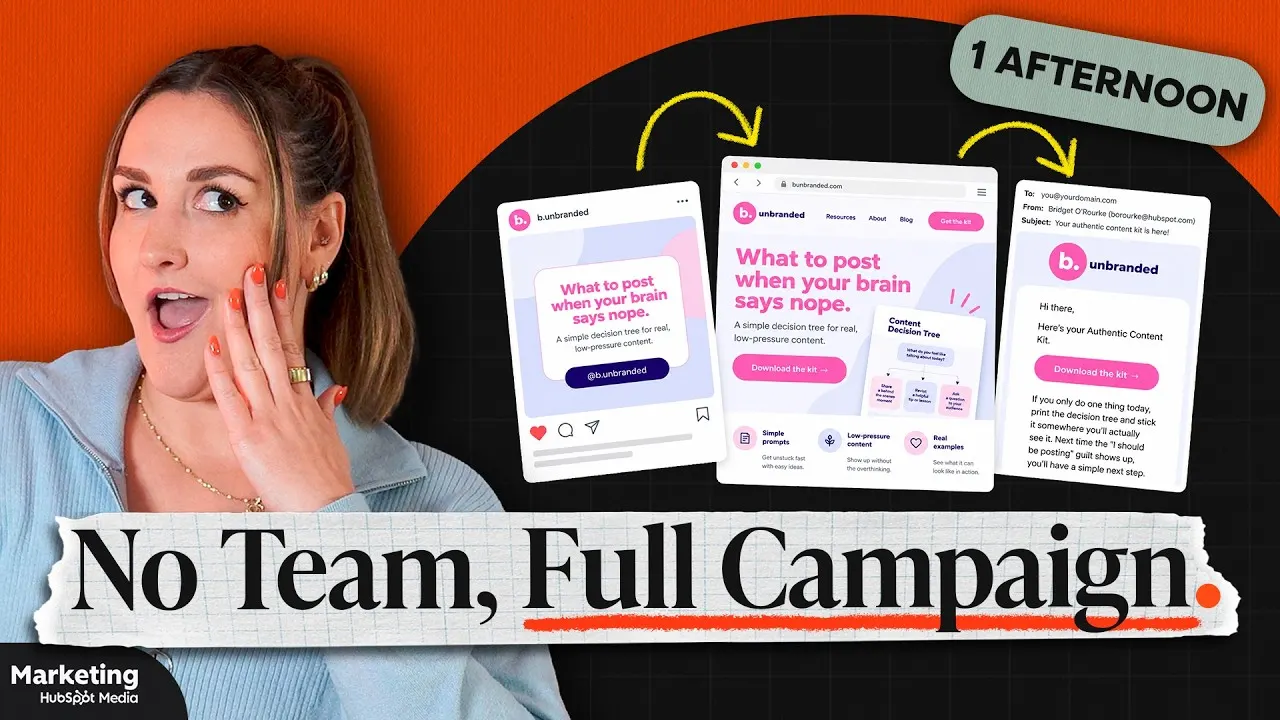
In the video below, HubSpot builds a marketing campaign with Claude in one afternoon. It shows the same habits: a full brief, a project with the business context, small steps, feedback on each piece and a saved skill for next time.
- One job your team does every week today.
- One reviewer with time in the calendar for every draft.
- One number, with its value before you start.
- One folder the team owns for briefs, prompts and checks.
- One date, 90 days later, to decide what comes next.
AI marketing results: one number per job
Measure each AI job against its own value before you started, with one main number per job. That can be hours spent, pieces made per week, conversion rate, replies or clicks from search. Record where the number comes from and the date. Without a starting value, nobody can say later whether AI helped.
Two kinds of numbers matter. Time numbers show whether AI saves work, such as hours per report. Result numbers show whether the work sells, such as replies, leads or clicks. A job can save time and still sell less, so pick one main number and watch a second one as a check.
Volume is not a result. CreatorFlow, the SaaS company one of our founders runs, has 647 published blog articles in English. Its blog clicks fell 56% from the first to the second half of October 2026. We found a ranking loss on the blog and are fixing it. A number you read every month shows a drop like this early.
| AI marketing job | Main number | Where you read it |
|---|---|---|
| Content drafts | Hours from brief to published piece | Your team’s time log or project tool |
| Product and ad images | Click or conversion rate of the new ads against the current ones | Your ad accounts |
| SEO briefs and page updates | Clicks from Google to the updated pages | Google Search Console |
| Weekly reporting | Hours to make the report each week | Your team’s time log |
| Personalised emails | Reply or click rate by segment | Your email tool or CRM |
| Market and customer research | Hours of research per campaign | Your team’s time log |
AI marketing at LeverCrew: RNJ Transport and CreatorFlow
At LeverCrew, AI does the production and one of our two founders reviews every piece. People with industry experience choose the buyer and the angle first. Our client proof is RNJ Transport, a road freight company in Lithuania. Our first test is CreatorFlow, the SaaS company one of our founders runs, so it is our own company and not a client.
For RNJ Transport, the new website went live 2 days after the first call, in 11 languages. In its first month, from 20 October to 21 November 2026, Google Search Console recorded about 3,000 clicks. No leads were recorded yet, so we claim none.
For CreatorFlow, 23.5% of Google search impressions from 14 October to 10 November 2026 were in Google’s AI features. For that reason, every content plan we write covers AI search as well as classic search.
Common questions
What is AI for marketing?
AI for marketing is the use of AI tools for marketing work: drafts of content, images and video, SEO briefs, reports, personalised versions of messages and research. People still decide the buyer, the angle and the claims, and they approve what goes live. In 2025, marketing or sales was the most common purpose of AI in EU companies.
Will AI replace marketing teams?
The survey data points the other way for now. In HubSpot’s 2026 survey, 73.4% of marketers said they see AI working together with marketers. AI does more of the production. Decisions about buyers, angles and claims stay with people who know the market and answer for the brand.
Do I have to label AI-generated marketing content in the EU?
Some of it. Since 2 August 2026, AI Act Article 50(4) asks you to disclose deep fakes, and AI text on matters of public interest unless a person reviewed it and someone holds editorial responsibility. The AI tool marks its output under Article 50(2). AI images of real people, products or places can count as deep fakes, so check them with your lawyer.
Which marketing jobs should we give to AI first?
Start with a job your team does every week from facts you already have: the weekly report, product texts, ad variants or SEO briefs. These jobs have a clear input, a draft a person can check and a number you can measure before and after. Keep one job for the first 90 days.
How do we measure the results of AI in marketing?
Give each AI job one main number, such as hours per report, conversion rate or clicks from search. Record its value before you start, where you read it and the date. Compare after 90 days. Watch a second number as a check, because a job can save time and still sell less.
Can we put customer data into ChatGPT or Claude?
Only in company accounts whose plan offers data processing terms, and only the data the job needs. Under GDPR Article 28, a provider that processes personal data for you needs a contract with you.
How long does AI in marketing take to show results?
Time savings show in the first weeks, because you measure hours directly. Results such as leads or search clicks take longer, so judge them after 90 days against the starting value. With LeverCrew, most projects go live in 10 working days, and monthly plans name one number we measure every month.
Sources and checks (9)
- Eurostat, Statistics Explained: use of artificial intelligence in enterprises (2025 data)
- Eurostat dataset isoc_eb_ai: AI use by purpose, EU and Spain, 2025 (checked November 2026)
- HubSpot: 2026 State of Marketing, data from 1,500+ global marketers
- Google Search Central: guidance on using generative AI content on your website
- European Commission, AI Act Service Desk: Article 50, transparency obligations
- European Commission, AI Act Service Desk: Article 3, definitions (deep fake)
- European Commission, AI Act Service Desk: implementation timeline (checked November 2026)
- European Commission: code of practice on marking and labelling AI-generated content (10 June 2026)
- GDPR, Regulation (EU) 2016/679, Articles 9, 21 and 28 (EUR-Lex)