AI for sales means AI that researches accounts, writes first drafts of outreach, updates the CRM, qualifies inbound leads and prepares calls. An AI SDR or AI sales agent does these steps for a seller. A person should approve what is sent, at least at the start. In Spain, LSSI Article 21 forbids commercial email the recipient did not request or expressly authorise, except to existing customers.
Key takeaways
- Tasks: AI sales agents research accounts, draft outreach, update the CRM, qualify inbound leads and prepare calls.
- Time: Gartner found AI saves sellers 4.8 hours a week on average, but 72% of sales organisations report low reinvestment of that time.
- Buyers: in a Gartner survey of 645 B2B buyers, 69% prefer to check AI-generated insights with a sales rep.
- Approval: a person approves the account list, the first message to each contact and the moment a lead passes to a seller.
- Law: in Spain, LSSI Article 21 forbids commercial email the recipient did not request or expressly authorise, except to existing customers.
- Bottom line: pilot one AI sales task for 6 weeks, with one approver and one number, before any agent sends on its own.
AI for sales: AI SDRs and AI sales agents
AI for sales is the use of AI for the work around a sale: researching accounts, writing first drafts of outreach, updating the CRM, qualifying inbound leads and preparing calls. An AI SDR, short for sales development representative, does the early steps a junior seller does today. An AI sales agent is the wider term for any AI that does sales steps for a person.
Gartner B2B buyer survey
Updated November 2026levercrew
Most B2B buyers prefer to check AI insights with a sales rep
Gartner survey of 645 B2B buyers, August to September 2025.
Also in the survey: 67% of the same buyers prefer a buying experience with no sales rep.
The time gain is real but not automatic. In a Gartner survey of 210 chief sales officers and senior sales leaders, run in January and February 2026, AI saved sellers an average of 4.8 hours a week. Yet 72% of sales organisations reported low reinvestment of that time in high-value sales work.
Buyers use AI too, and they still want a person. In a Gartner survey of 645 B2B buyers from August to September 2025, 45% said they used generative AI during a recent purchase. 67% prefer a buying experience with no sales rep, yet 69% prefer to check AI-generated insights with a sales rep.
This guide is for the sales lead or owner of a small or mid-size company that sells to other businesses. Content and campaigns have their own guide: AI for marketing.
AI SDR tasks and human approval
AI sales agents do six sales tasks well: account research, first drafts of outreach, CRM updates, first replies to inbound leads, call preparation and follow-up after calls. In each task, the AI gathers the facts and writes the first version. A person decides who to contact, what to promise and when a lead is ready for a seller.
CRM vendors now build these tasks into their products. HubSpot’s prospecting agent reads up to a year of engagement on a contact record, such as form submissions, page views, calls and meetings. It drafts personalised outreach that a rep can review, edit or write again before outreach starts. Salesforce describes Agentforce SDR as a first point of contact for inbound leads that can answer questions and book meetings for sellers.
| Sales task | What the AI does | What a person keeps |
|---|---|---|
| Account research | Reads the company website, news, job posts and your CRM history, and writes a short profile | Which accounts fit your target list |
| First drafts of outreach | Writes a first email or message for each contact from the profile and your offer | The promise, the tone and the approval before sending |
| CRM updates | Logs emails, calls and notes, and completes missing fields | A check that the data is right before reports use it |
| Inbound lead qualification | Answers first questions, asks your qualifying questions and books meetings | The rules for a qualified lead and every exception |
| Call preparation | Collects past emails, calls and account news in one brief before the call | The plan for the call and the relationship |
| Follow-up after calls | Writes a summary, next steps and a draft follow-up email from the call notes | What you agreed with the buyer |
Approval points for an AI sales agent
A person should approve three things before an AI sales agent acts: the list of accounts, the first message to each new contact and the moment a lead passes to a seller. Start with approval on every message. Give the agent more freedom one segment at a time, once its drafts need few changes.
Approval points
Updated November 2026levercrew
A person approves the list, each first message and the handover
One new contact, from research to call
- AI builds the profile Website, news, CRM history
- You approve the list Accounts that fit
- AI drafts the message One for each contact
- You approve the message Before anything is sent
- A seller takes the call When the lead is ready
HubSpot Academy describes the same path for its prospecting agent. Teams start with drafts that reps review, then move single plays to automatic sending as they trust the output. A play is HubSpot’s name for one target group with its buying signals, contacts and selling context.
Gartner predicts that by 2028 AI agents will outnumber sellers ten to one, yet fewer than 40% of sellers will say the agents improved their productivity. Its advice is to fix the data and the workflow first, because more agents do not bring more productivity on their own.
In the AI workflows we build for sales teams, the agent starts with read-only access where possible, proposes each message for your approval and logs every action. Everything runs in your own accounts.
Cold email and call rules in the EU and Spain
AI outreach follows the same rules as a message a person sends. In the EU, email for direct marketing to individuals needs prior consent, with an exception for your own customers. Spain’s LSSI Article 21 forbids promotional email that recipients did not request or expressly authorise, and its text makes no exception for company addresses.
Article 13(1) of the ePrivacy Directive allows email for direct marketing only to people who gave prior consent. Article 13(2) lets a company email its own customers about its own similar products, if they can object free of charge when the data is collected and in every message. Article 13(5) applies these rules to natural persons and leaves the protection of companies to each country.
The GDPR covers the personal data behind every message. Recital 47 says direct marketing may be regarded as a legitimate interest, the legal basis in Article 6(1)(f), when the person’s interests and rights do not override it. Under Article 14(3)(b), if the data came from another source, you inform the person at the latest in the first message. Under Article 21, they can object at any time, and you then stop.
Spain adds three more rules. LSSI Article 20 says a commercial email must be clearly identifiable as commercial, and so must its sender. Article 66 of the General Telecommunications Law 11/2022 gives people the right to refuse unwanted commercial calls without prior consent or another GDPR legal basis, and automated calls without prior consent. LOPDGDD Article 23 asks anyone who plans direct marketing to check the advertising exclusion systems first. This guide is not legal advice, so check your outreach with your lawyer.
| Channel | Rule | Where it is written |
|---|---|---|
| Email to a person in the EU | Prior consent, or your own customer for similar products with a free way to object | ePrivacy Directive, Article 13(1) and 13(2) |
| Email to any recipient in Spain | A prior request or express permission, or an existing customer for similar products | LSSI, Article 21 |
| Any commercial email in Spain | Clearly commercial, with a clear sender and a valid address to object | LSSI, Articles 20 and 21 |
| Personal data behind any message | A legal basis such as legitimate interest, information by the first message, the right to object | GDPR, Recital 47 and Articles 6, 14 and 21 |
| Commercial calls in Spain | Prior consent or another GDPR legal basis; prior consent for automated calls | General Telecommunications Law 11/2022, Article 66 |
| Any direct marketing in Spain | A check of the advertising exclusion systems before you start | LOPDGDD, Article 23 |
Platform rules for AI outreach: Gmail, LinkedIn and the AI Act
Platforms add rules of their own on top of the law. Gmail asks every sender to keep the spam rate below 0.3%. Senders of more than 5,000 messages a day must also authenticate with SPF, DKIM and DMARC and offer one-click unsubscribe on marketing messages. LinkedIn’s User Agreement forbids bots and unauthorised automated methods that add contacts or send messages.
Gmail sender guidelines
Updated November 2026levercrew
Keep spam reports under 0.1%, and never reach 0.3%
Spam rate in Postmaster Tools, in per cent
0 Goal: under 0.1% 0.5
Above 5,000 messages a day: SPF, DKIM and DMARC, plus one-click unsubscribe on marketing messages.
Google’s guidelines also ask all senders to use SPF or DKIM, and give 0.1% as the spam rate to stay under. Send AI outreach in small volumes at first, and read the spam rate in Postmaster Tools every week.
LinkedIn’s User Agreement, effective 3 November 2025, also forbids software, scripts or robots that scrape or copy profiles and other data. A tool that sends LinkedIn messages or adds contacts through a browser bot breaks these terms. Let the AI draft the message, and have a person send it.
When an AI agent talks to people, for example in a chat that qualifies inbound leads or in replies to email, AI Act Article 50(1) applies since 2 August 2026. The provider must design the system so people know they are talking to an AI, unless that is obvious. Article 50(5) says people must learn it at the latest at the first interaction. Ask your tool provider how it does this.
AI sales tools by type
AI sales tools come in five types: AI agents inside your CRM, standalone prospecting platforms, sales engagement tools with AI features, general AI assistants such as Claude or ChatGPT, and custom workflows on the tools you already have. The right type depends on where your contact data lives and how much the AI should do without a person.
Start from your CRM. If your contacts and their history live in HubSpot or Salesforce, the CRM’s own agent reads that history without a new connection. A standalone platform brings its own contact data and sending. That makes it a new processor under GDPR Article 28, with its own contract. Under Article 14(2)(f), you also tell each person which source their data came from.
General assistants are the easiest start, because many sellers already use them for research and writing. Our 30-day plan for Claude Code and Claude Cowork in a commercial team shows one way to add them to the weekly work. The table compares the five types by scope. Prices change often, so check them on each vendor’s own page.
| Tool type | What it does | Fits when | Check before you buy |
|---|---|---|---|
| AI agent in your CRM | Drafts outreach from your CRM history, such as HubSpot’s prospecting agent or Salesforce Agentforce SDR | Your contacts and history already live in that CRM | Which actions it takes without approval |
| Standalone prospecting platform | Finds contacts, writes and sends sequences, and handles replies | You need new contacts and have no outbound team | The source of its contact data, and the processing contract |
| Sales engagement tool with AI | Adds AI drafts and reply sorting to the email sequences your team runs | Your team already sends sequences | Who approves each AI draft |
| General AI assistant | Helps a seller research, prepare calls and draft emails, such as Claude or ChatGPT | A seller wants help with research and writing | A company plan, and the data the team may paste |
| Custom workflow on your tools | Runs one sales task the same way every time on your own tools | The task is clear and repeats every week | Who owns the workflow and keeps it running |
AI SDR pilot in 6 weeks
Run a 6-week pilot on one sales task, one segment and one approver before any AI agent sends on its own. Record the number before you start, such as hours of research per account or the reply rate to first emails. In week 6, compare and decide: stop, keep the approval step, or give the agent more freedom in that one segment.
Weeks 1 and 2. Choose the task and the segment, for example 50 target accounts in one industry. Write the target profile, the offer and the rules for what the AI may say. Connect the AI to the CRM with read-only access where possible. Check the legal basis and the email rules for that segment before the first message.
Weeks 3 and 4. The AI researches and drafts. The approver reads every draft, edits it, sends it and logs each edit. When the same edit repeats, add it to the instructions so the next drafts start better.
Weeks 5 and 6. Compare the number with its starting value. Count how many drafts were sent with no changes. If the drafts need few changes, give the agent more freedom in that segment only. Our AI ROI calculator shows what the saved hours are worth each month.
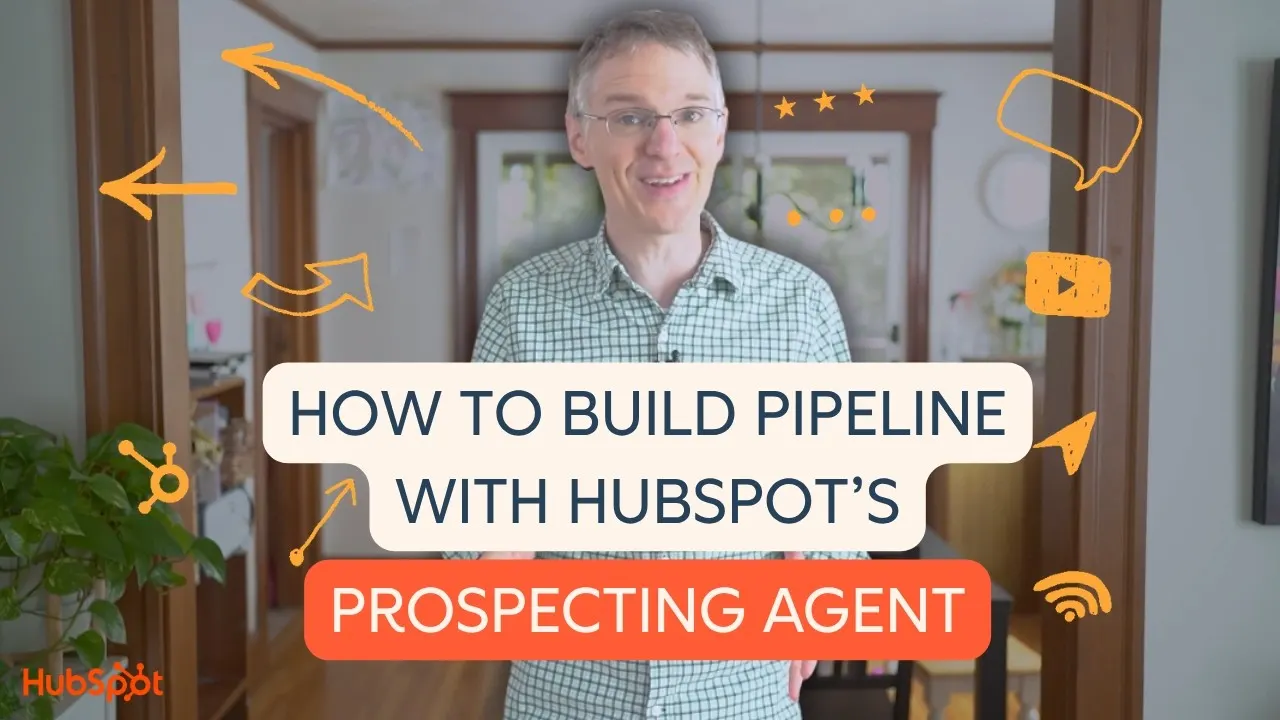
In the video below, HubSpot Academy shows its prospecting agent, including the setting that starts with drafts a rep reviews.
- One task: research, first drafts, CRM updates or call preparation.
- One segment, such as one industry or one country.
- One approver who reads every draft in weeks 3 and 4.
- One number, with its value before you start.
- One legal check for the segment: legal basis, email rules and objections.
AI for sales at LeverCrew
At LeverCrew, we start from the sales task and the result your team needs, then build the AI workflow on the tools you already have. People with real sales experience lead the work: Lautaro has more than 10 years in sales, marketing and B2B business. You approve what is sent, and everything runs in your own accounts.
Our prospect research workflow researches each company on your target list: what it sells, who decides and what is new. Your sellers get a short profile and a first message draft for each prospect. We show your team how the workflow runs, and you keep the documentation.
If your team wants to run the work itself, our AI training for sales and marketing teams includes a step on AI for prospecting. The team researches companies on its own target list with AI and writes a first message for each one, with Claude, Claude Cowork and Claude Code.
We have no client results from AI prospecting to show yet, so we claim none.
Common questions
What is an AI SDR?
It is AI that does the early work of a sales development representative. It researches accounts, writes first drafts of outreach, updates the CRM and answers first questions from inbound leads. A person sets the target, approves the messages and takes the call when a lead is ready.
Can an AI SDR replace a human sales rep?
Not for most B2B sales today. In a Gartner survey, 69% of B2B buyers said they prefer to check AI-generated insights with a sales rep. Use the AI for research and drafts, and keep people on calls and decisions.
Is cold email legal in Spain?
Only in narrow cases. Spain’s LSSI Article 21 forbids promotional email that the recipient did not request or expressly authorise. The exception is an existing customer, for similar products, with a simple and free way to object in every message. The article makes no exception for company addresses, so check B2B campaigns with your lawyer.
Do I need consent to call prospects in Spain?
For automated calls without a person, yes: Article 66 of the General Telecommunications Law 11/2022 asks for prior consent. Other commercial calls need prior consent or another legal basis under GDPR Article 6(1), such as legitimate interest. LOPDGDD Article 23 also asks you to check the advertising exclusion systems first.
Does an AI sales agent have to say it is an AI?
When it talks to people directly, yes. Since 2 August 2026, AI Act Article 50(1) asks providers to design such systems so people know they are talking to an AI, unless that is obvious. Under Article 50(5), they must learn it at the latest at the first interaction.
Can an AI agent send LinkedIn messages for us?
Not through bots. LinkedIn’s User Agreement forbids bots and other unauthorised automated methods that add contacts or send messages. Let the AI research the account and draft the message, and have a person send it from their own LinkedIn account.
How long should an AI SDR pilot run?
We use six weeks for one task in one segment: two weeks to prepare, two with a person approving every draft and two to compare the number with its starting value. Give the agent more freedom only in the tested segment, once its drafts need few changes.
Sources and checks (14)
- Gartner: AI saves sellers nearly 5 hours per week, yet 72% fail to reinvest the time (19 May 2026)
- Gartner: 69% of B2B buyers turn to sales reps to validate AI-generated insights (20 May 2026)
- Gartner: AI agents will outnumber sellers 10 to 1 by 2028 (28 July 2026)
- HubSpot Knowledge Base: use the prospecting agent (checked November 2026)
- HubSpot Academy: HubSpot Prospecting Agent, video and description (June 2026)
- Salesforce Trailhead: get to know Agentforce SDR
- ePrivacy Directive 2002/58/EC, consolidated text, Article 13: unsolicited communications (EUR-Lex)
- GDPR, Regulation (EU) 2016/679, Recital 47 and Articles 6, 14, 21 and 28 (EUR-Lex)
- Spain, Ley 34/2002 (LSSI), consolidated text, Articles 20 and 21 (BOE, in Spanish)
- Spain, Ley 11/2022 General de Telecomunicaciones, Article 66 (BOE, in Spanish)
- Spain, Ley Orgánica 3/2018 (LOPDGDD), Article 23: advertising exclusion systems (BOE, in Spanish)
- Google Workspace Admin Help: email sender guidelines (checked November 2026)
- LinkedIn User Agreement, section 8.2 (effective 3 November 2025)
- European Commission, AI Act Service Desk: Article 50, transparency obligations