To validate a SaaS idea, collect evidence before you write code that one group of buyers has the problem and will pay to solve it. Talk to 10 to 30 of them about the last time it happened, check search demand and competitors, and test 3 to 5 angles on landing pages. Then ask for a pre-order or a paid pilot. Build when money or signed orders arrive.
Key takeaways
- Evidence: a payment or a signed pre-order counts most, then a booked call. A like counts for nothing.
- Interviews: ask about the last time the problem happened, never “would you use it”. Typical studies use 10 to 30 people.
- Competitors: paid competitors prove demand. The test is what current tools leave open for one segment.
- Angles: test 3 to 5 reasons to buy, one per landing page with the same traffic, and count signups per angle.
- EU rules: a waiting list needs a clear notice and real consent. Spain’s LSSI bans promotional emails nobody asked for.
- Bottom line: write the number that means “build” before each test, and build only when buyers pay or sign.
SaaS idea validation in four stages
To validate a SaaS idea is to collect evidence, before you write code, that one group of buyers has a problem, looks for help with it and will pay to solve it. You do it in four stages: problem interviews, a demand check, an angle test on landing pages and a pre-sale. Each stage ends with a test you write down before you start.
This guide is for SaaS founders, and for product or marketing leads with a new product or module. The goal is a clear answer in a few weeks: will people pay, and for which reason to buy.
A common belief says the best ideas sit in trades with no software, such as vets, garages or small accountancies. Search for software for any of them and you find products built for each. Paul Graham wrote in 2012 that a crowded market is a good sign, because it shows demand and shows that no existing product is good enough. The test is whether one segment has a problem current tools leave open.
Graham also wrote that the most common mistake is to solve problems no one has. The four stages test for that mistake with evidence.
| Stage | Question it answers | Test | Evidence that ends it |
|---|---|---|---|
| Problem interviews | Does one group have this problem often, and what does it cost? | 10 to 30 interviews about the last time it happened | Our rule: most describe the same problem and a costly workaround |
| Demand check | Do people search for help and pay for tools? | Search volumes, competitors and their reviews | Searches or paid competitors, plus complaints you can answer |
| Angle test | Which reason to buy makes people act? | One landing page per angle, same traffic | One angle passes a signup number set in advance |
| Pre-sale | Will they pay before the product exists? | A pre-order, a paid pilot or a version delivered by hand | Money or a signed order from outside your network |
Evidence that counts when you validate a startup idea
Evidence counts when it costs the buyer something: money, time or the facts of their own work. A payment or a signed pre-order is the strongest proof. A booked call comes next, then a reply that describes a real problem, then an email on a waiting list. A like or a compliment says nothing about buying.
Evidence ladder
Updated November 2026levercrew
Evidence counts more when it costs the buyer something
From strongest to weakest
- Payment or signed pre-order The buyer risks money Money
- Booked call or pilot The buyer gives time and data Time
- Reply with a real problem A past case, in their words Facts
- Email on a waiting list Interest that costs nothing Interest
- Like or compliment Polite, says nothing about buying Noise
Our rule: a stage passes only on evidence from the top three rows.
Y Combinator lists three errors in conversations with users: you talk about your idea, you talk about hypotheticals and you talk too much. Each one invites polite answers. A yes to “would you use this?” costs the person nothing.
Eric Migicovsky based that Y Combinator talk on The Mom Test, Rob Fitzpatrick’s book on how to avoid biased feedback and how to tell whether someone will buy.
Our rule: a stage passes only on evidence from the top three rows of the ladder. Waiting-list emails and likes help you find people to talk to. They do not tell you to build.
Problem interviews to validate a business idea
Problem interviews are one-on-one conversations with people who have the problem, about the last time it happened. You ask what they did, what it cost and what they tried. You do not present your idea. In typical voice-of-the-customer studies, 10 to 30 customers are interviewed one on one, for about an hour each.
Start with one segment: one role, one company size, one industry. Mixed segments give mixed answers. Find people in your network, in the communities where they ask for help and through introductions.
Y Combinator suggests five questions, here in short form. What is the hardest part of the job? Tell me about the last time you had this problem. Why was it hard? What, if anything, have you done to solve it? What do you dislike about the things you have tried?
Take detailed notes, because you do not know yet which fact will matter. Y Combinator suggests that a co-founder takes the notes, or that you ask permission to record the call.
Customers find it hard to name their needs when you ask directly, so infer them from stories of real experiences. Voice-of-the-customer interviews usually produce 75 to 150 phrases that describe needs. Keep them in the customer’s own words, because those words become your angles.
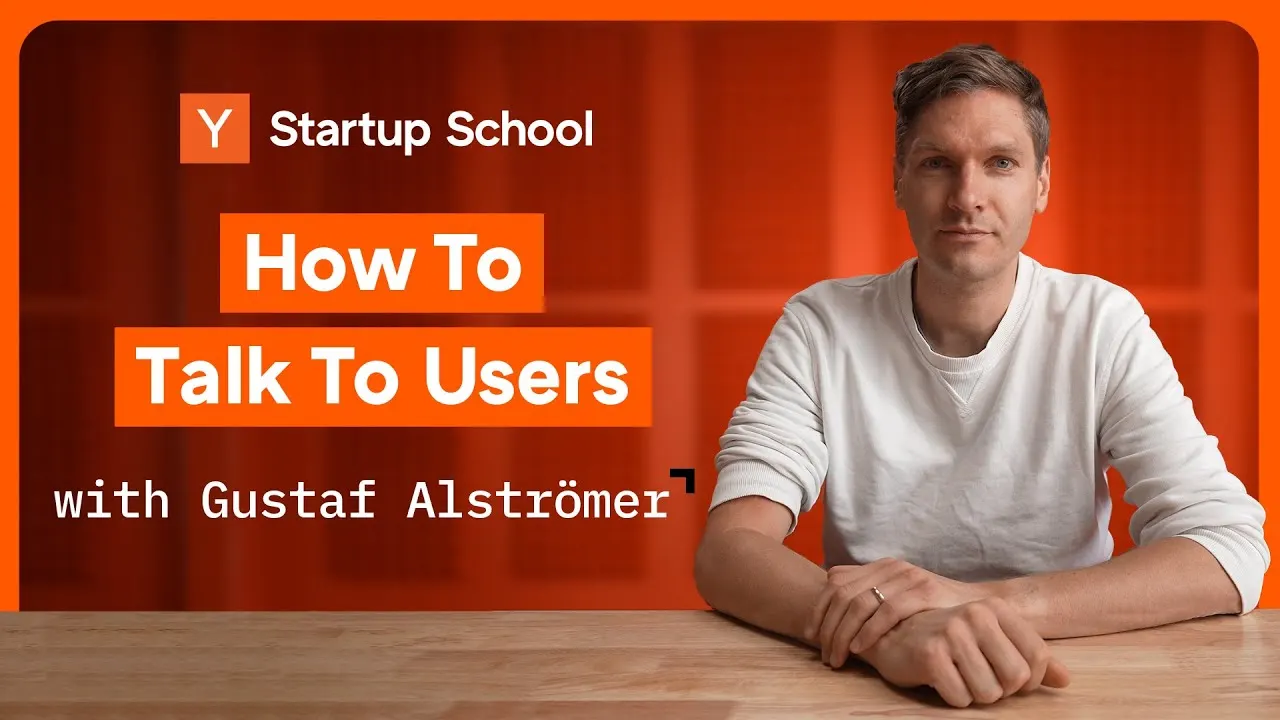
In the video below, Y Combinator group partner Gustaf Alströmer explains who to talk to, how to interview potential customers and which questions to avoid.
Demand check with search volume and competitors
A demand check shows whether people already look for help with the problem and pay for tools. Check search volumes in Google Keyword Planner, list the products that solve the problem today, and read what their users complain about. Paid competitors are good news, because they prove that buyers spend money on this problem.
Keyword Planner estimates monthly searches for a keyword and its close variants, in the locations you choose. Google rounds them, so read them as a size. The Competition column shows how many advertisers appeared on a keyword compared with all keywords. You need a Google Ads account with billing information to use it.
Few searches do not end an idea, because people only search for problems they can name. Read the pricing pages, help pages and reviews of your top three competitors, and list every complaint that repeats. A complaint your interviews also heard is the best result of this stage.
We build for searched demand in our own company. CreatorFlow, the Instagram DM automation SaaS that one of our founders runs, has 61 comparison pages, 72 pages for each type of user and 46 free tools in English, each made for a search that buyers make. The CreatorFlow case study shows how the site grew.
Angle tests on a SaaS landing page
An angle is one reason to buy, said in one way. The same product can sell on time saved, on lower cost or on less risk. An angle test puts 3 to 5 angles in front of the same kind of buyer, one angle per landing page or message, and counts who acts on each one.
One test page
Updated November 2026levercrew
Each test page sells one angle and asks for one action
A test page, top to bottom
Phone screen edge
Our rule: every angle gets the same layout, the same traffic source and the same week, so the counts compare.
We use the same method for ads: the buyer and the angles first, then variants of each angle, so the team can test which one sells. For a SaaS idea, take the angles from your interviews, in the buyers’ words, and build one page per angle with the same layout, offer and form.
Show a price, even a first one. Without a price, a signup shows interest. With one, it says more about what people will pay. Our rule: send the same traffic source to every page in the same week, and write down the winning number before the test.
You do not need a developer for a test page. App builders make one from a written prompt, and our guide to Lovable alternatives compares them. If you want the angles and the variants made for you, our AI content for ads and launches starts from the same brief.
Pre-sales and concierge pilots before you build
A pre-sale asks the buyer to commit before the product exists: a pre-order, a paid pilot or a signed order with a start date. A concierge pilot delivers the result by hand, with spreadsheets, existing tools and your own time, while the buyer pays as if it were software. Both turn interest into evidence that costs the buyer something.
In “Do Things that Don’t Scale”, Paul Graham writes that founders at the start most often recruit users by hand, and can sometimes do by hand what they plan to automate later.
Ask for the commitment in a call. Say what the pilot delivers, for how long, what it costs and what happens at the end. If the buyer cannot pay yet, ask for a signed order with a start date.
Consumers in the EU can cancel a service bought online within 14 days of the day the contract was agreed, so plan for refunds in a consumer pre-sale. Record who paid, who said yes without paying and who said no, and why.
AI in idea validation: what it speeds and what stays with people
AI speeds the desk work of idea validation: interview guides, transcripts, keyword research, competitor summaries and landing page variants. It does not replace the people you interview. Use Claude or another assistant to prepare and to sort what buyers said, and keep the conversations with buyers for yourself.
A 2024 study in Political Analysis tested ChatGPT as a stand-in for survey respondents. Its answers varied less than real ones, changed with small edits to the prompt, and the same prompt gave different results over 3 months. An AI buyer is a rehearsal, never evidence.
The table shows what AI does in each validation task and what a person does.
| Task | What AI does | What a person does |
|---|---|---|
| Interview guide | Drafts questions for your segment and removes hypothetical or leading ones | Chooses who to call and runs the interview |
| Interview notes | Transcribes recorded calls, with permission, and tags problems, workarounds and costs | Reads every transcript that disagrees with the rest |
| Demand check | Groups keywords and summarises competitor pages and reviews | Decides which complaint is worth a product |
| Angle test | Writes 3 to 5 page and ad variants, one angle each | Picks the angles from the interviews and checks every claim |
| Pre-sale | Drafts the pilot offer and the order form | Asks for the commitment, in a call |
| Rehearsal | Plays a sceptical buyer so you can practise answers to objections | Never counts the rehearsal as evidence |
EU rules for waiting lists and interview emails
In the EU, a waiting list collects personal data, so the GDPR applies. Tell people who you are, why you collect their email, how long you keep it and what their rights are. Ask for separate consent before you send updates. In Spain, the LSSI also bans promotional emails that the recipient did not ask for or authorise.
The European Commission lists what you tell people when you collect their data: who you are, the purposes, the legal basis, how long you keep it, who receives it and their rights, in clear and plain language.
Consent must be freely given, informed and specific, through an affirmative act such as ticking a box. Withdrawing it must be as easy as giving it, and you must be able to show that the person agreed.
If you found someone’s address in a public directory, tell them where you got it within one month at the latest; your first message can do that. In Spain, LSSI Article 21 bans promotional emails nobody requested or authorised, except to existing customers about similar products. The LSSI counts any message that promotes a company, directly or indirectly, as commercial, so keep an interview request about the person’s work, with no offer. This guide is not legal advice, so check your case with your lawyer.
| What you do | Rule | What it means for the test |
|---|---|---|
| Waiting-list form | GDPR information duty | A short notice under the form: who, why, how long, rights |
| Updates to the list | GDPR consent | An unticked box, a record of each consent, an easy way to leave |
| Email to people from directories | GDPR duty for data from other sources | The first message says who you are and where you found the address |
| Promotional email in Spain | LSSI Article 21 | Only to people who asked or agreed, with an opt-out address |
| Ad or analytics cookies in Spain | LSSI Article 22.2 | Consent first, so count signups in your own list too |
| Pre-orders from consumers | EU right of withdrawal | 14 days to cancel a service from the day of the contract |
The decision to build a SaaS product
Start building when buyers in one segment have described the same problem, one angle has won the landing page test, and people have paid or signed before the product exists. After that, the first users test the product itself. Sean Ellis asks them how they would feel without it, and he treats 40% “very disappointed” as product/market fit.
Product/market fit survey
Updated November 2026levercrew
Ellis’s line: 40% of users would be “very disappointed” without it
Users answering “very disappointed”
0 % Ellis line: 40% or more 100 %
Ask only users who came back. Superhuman asked people who used it at least twice in two weeks, and read results from about 40 answers.
Ellis asks people who have come back at least once, after using the core of the product, so the survey belongs to your first version or pilot, never to a waiting list. He set the 40% line after benchmarking nearly a hundred startups.
Superhuman asked people who had used its product at least twice in two weeks. Its first score was 22%, and it later reached 58%. Its founder wrote that results become directionally correct at about 40 answers.
Check platform rules before you decide. CreatorFlow sends Instagram messages through Meta’s official API, and Meta approved it as a Tech Provider in December 2025. If your product depends on another company’s platform, read its approval steps while you validate.
Our guide on how to launch and scale a SaaS covers the next stages. For buyers, angles, test pages and launch content, see our work for SaaS and software companies.
Common questions
How do you validate a SaaS idea without building it?
Talk to 10 to 30 people in one segment about the last time they had the problem. Check search volumes and competitors, and test 3 to 5 angles on landing pages. Then ask for a pre-order or a paid pilot, and deliver the first results by hand.
How many customer interviews do you need to validate an idea?
In typical voice-of-the-customer studies, 10 to 30 customers are interviewed one on one, for about an hour each. Stop when new interviews bring no new problems. Our rule: if every interview describes a different problem, narrow the segment first.
Is a waiting list enough to validate a startup idea?
No. A waiting-list email costs the person nothing, so it shows interest, not buying. Use the list to find people for interviews and pilots. Count as proof a booked call, a reply that describes a real problem, a signed order or a payment.
Can AI replace customer interviews?
No. A 2024 study in Political Analysis found that synthetic survey answers from ChatGPT varied less than real ones and changed with small edits to the prompt. Use AI to prepare questions, sort notes and rehearse objections. The evidence comes from real buyers.
Can I send cold emails to find interview partners in Spain?
With care. LSSI Article 21 bans promotional emails nobody requested or authorised, and a request that promotes your product can count as one. Write about the person’s work, make no offer, say where you found the address and ask a lawyer.
What is a good result in a landing page test?
Compare your angles with each other, not with an average from another market. Send the same traffic to each page in the same week, show a price and write down the winning number before you start. The winning angle goes into your pre-sale.
When should I stop validating and start building?
Build when people in one segment describe the same problem, one angle wins your test and buyers pay or sign before the product exists. Sean Ellis’s 40% survey comes later, once people use the first version.
Sources and checks (15)
- Paul Graham: How to Get Startup Ideas (November 2012)
- Paul Graham: Do Things that Don’t Scale (July 2013)
- Y Combinator: Startup School week 1 recap, the five interview questions and three errors (4 September 2019)
- Eric Migicovsky: Startup School, how to talk to users (25 July 2019)
- Rob Fitzpatrick: The Mom Test
- Gaskin, Griffin, Hauser, Katz and Klein: Voice of the Customer (MIT Sloan, PDF)
- Google Ads Help: Use Keyword Planner (checked November 2026)
- Google Ads Help: About Keyword Planner forecasts (checked November 2026)
- First Round Review: How Superhuman built an engine to find product/market fit (12 November 2018)
- Venture Hacks: interview with Sean Ellis on product/market fit (14 December 2009)
- Bisbee, Clinton, Dorff, Kenkel and Larson: Synthetic Replacements for Human Survey Data? Political Analysis, 2024
- European Commission: information to give to people whose data you collect (GDPR)
- European Commission: when consent is valid (GDPR)
- BOE: Ley 34/2002 (LSSI), Articles 20, 21, 22 and Annex, consolidated text of 23 January 2025 (checked November 2026)
- Your Europe: returns and the right of withdrawal (checked November 2026)