To launch a SaaS, build the smallest version that does one job for one type of user, give it by hand to the people you interviewed, and measure who keeps using it. Scale only when retention by signup week flattens and more than 40% of active users would be "very disappointed" without it. Then grow through channels that compound: SEO, AI search, content and partnerships.
Key takeaways
- Three stages: validate, launch and scale. Each one ends with a test, not with a date.
- MVP: one job for one type of user, planned in weeks, with a fixed launch date.
- First users: recruit them by hand, starting with the people you interviewed, before any public launch.
- Fit test: more than 40% of active users would be "very disappointed" without the product, and retention flattens.
- Scale: retention before ad spend, then the channels that compound: SEO, AI search, content and partnerships.
- Bottom line: go to the next stage only when the test of the current one passes, and measure one number every week.
SaaS launch and scale stages
A SaaS goes through three stages: validate, launch and scale. Each stage ends with a test, not with a date. Validation ends when people with the problem commit something. The launch ends when active users depend on the product. Scaling starts after that, and each channel you add has to keep bringing users without a person doing every step by hand.
Each stage costs more than the one before it: interviews cost less than code, and code costs less than ads. A team that moves early pays the higher cost for a product people do not use yet.
This guide is for the founder or commercial lead of a small software company. One of our founders co-founded CreatorFlow, a SaaS company he runs every day, so we write from our own work. The table shows each stage, its test and its number.
| Stage | What you do | Test that ends it | Number to watch |
|---|---|---|---|
| Validate | Talk to people who have the problem now and ask for a commitment | People commit: a pre-order, a paid pilot or a fixed date to try the first version | Commitments from the people you interviewed |
| Launch | Build the smallest version for one job and give it to those people by hand | More than 40% of active users would be "very disappointed" without it | Retention by signup week and the share of "very disappointed" answers |
| Scale | Add channels that keep working: SEO, AI search, content and partnerships | Each channel brings new users every month without a person doing each step | Weekly growth of revenue, or of active users before you charge |
Validation before the SaaS MVP
Validate before you write code. Talk to people who have the problem now, ask about the last time it happened, and ask for a commitment at the end. A pre-order, a paid pilot or a fixed date to try the first version counts as proof. Compliments and "I would use that" do not count.
Paul Graham’s test for an idea is one question: who wants this right now? He adds a second one: who wants it so much that they will use it even in a rough first version? At Y Combinator’s Startup School, Eric Migicovsky tells founders to ask about specifics that already happened in the person’s life, not about the product they plan to build.
You can ask Claude or ChatGPT to play a sceptical buyer and test your interview questions before the first call. The answers come from a model, not from your market, so they never replace the interviews. Our guide on how to validate a SaaS idea covers the interview questions and the proof in detail.
SaaS MVP scope: one job for one type of user
A SaaS MVP is the smallest version of the product that does one job for one type of user, from the first screen to the result. Plan it in weeks, not months. List every feature you want, then cut until only the steps of that one job are left. Everything else waits for what the first users tell you.
A three-week MVP plan
Updated November 2026levercrew
Write the spec, cut it, build one job and launch in week three
From spec to first users
- Day 1 Write the full spec
- Day 2 Cut what can wait
- Week 1 Build the one job
- Week 3 Launch to your interviewees
- Week 4 Weekly calls with users
Timebox: only what you can build before the launch date belongs in the spec. The rest waits for the first users.
At Y Combinator’s Startup School, Michael Seibel tells founders to launch quickly and to build the MVP in weeks, not months. His method is to timebox the spec, the list of things to build before the launch: if you want to launch in three weeks, only what you can build in three weeks belongs in the spec. In a 2018 essay, he writes that Airbnb’s first version was built in under a month.
A plan built on that method looks like this. Write the full spec on day 1 and cut it on day 2. Build the one job from week 1 and launch it to the people you interviewed in week 3. From week 4, talk to each user every week.
AI coding tools make the build part shorter. Claude Code, for example, reads your codebase, edits files and runs commands. A person still decides the scope and checks what the tool wrote, above all the parts that touch payments, logins and customer data.
Check what your product depends on before you fix the date. If it runs on another company’s platform, that company’s approval belongs in the plan. CreatorFlow, our own SaaS for Instagram messages, runs on Meta’s official API, and Meta approved it as a Tech Provider in December 2025.
- In the MVP: the one job, from the first screen to the result.
- In the MVP: a way to sign in and a way for users to reach you.
- In the MVP: one number you can read every week.
- Later: settings, roles, integrations and a second type of user.
How to launch a SaaS to your first users
Launch the MVP to the people you interviewed first, one by one. Help each of them start, watch where they get stuck and talk to each of them every week. A public launch on Product Hunt or Hacker News comes later, when people who have never heard of you can try the product without your help.
In "Do Things that Don’t Scale", Paul Graham writes that recruiting users by hand is the most common thing founders must do at the start that does not scale. You cannot wait for users to come to you. He describes the Stripe founders: when someone agreed to try Stripe, they said "Right then, give me your laptop" and installed it on the spot.
In the same essay, Graham says the big launch usually does not work. How well you do a few months later depends more on how happy you made those first users. He tells founders to give users an excellent experience even with an early, incomplete product.
Show the product in public when strangers can try it alone. Show HN on Hacker News is for things people can try, ideally without a sign-up or an email, and its rules say not to post landing pages or fundraisers. The maker must be in the thread to answer. On Product Hunt, every launch goes live at 12:01 AM Pacific Time on the day you schedule. Its launch guide says never to ask for upvotes and never to use fake or extra accounts.
Decide how strangers start before the public launch. CreatorFlow has a free plan, and its paid plans start with a 14-day free trial. Both let a new user try the one job before anyone talks to them.
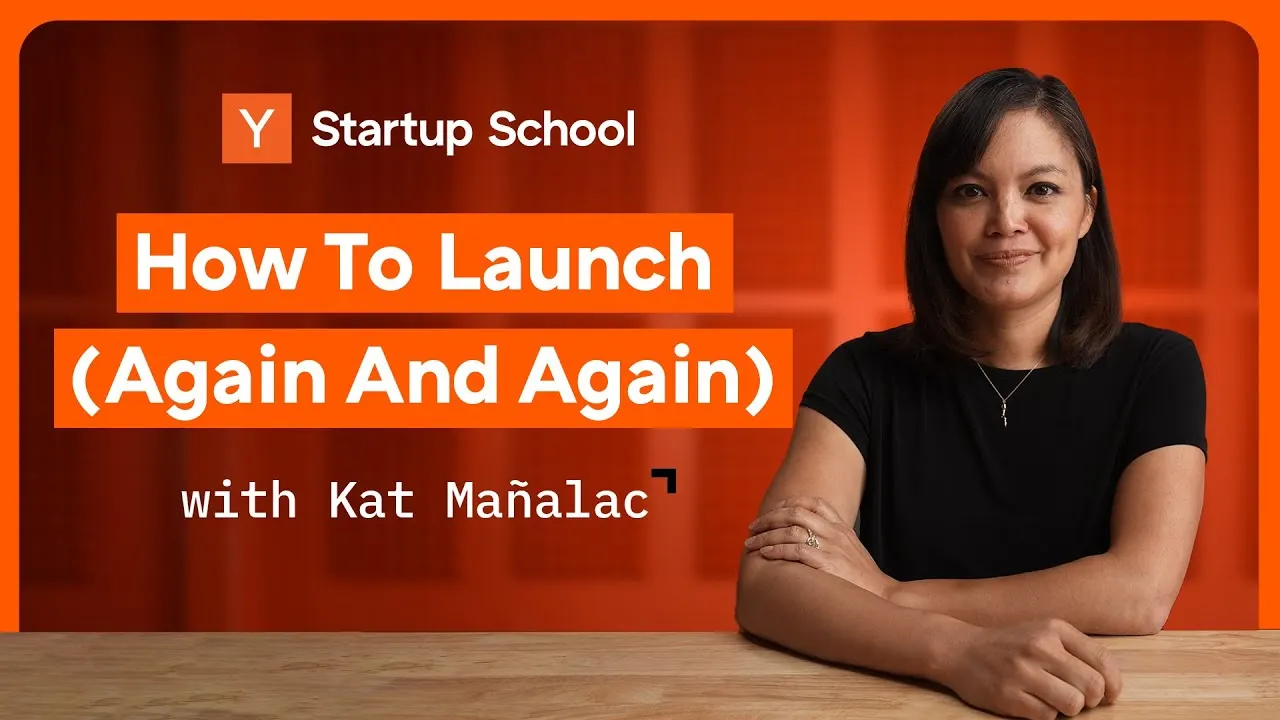
In the video below, from 2023, Kat Mañalac of Y Combinator explains when to launch, how to describe the product in one sentence and the types of launch a startup can do.
Product-market fit test after the launch
The launch stage ends when users depend on the product. Sean Ellis’s test asks active users one question: how would you feel if you could no longer use the product? If more than 40% answer "very disappointed", Ellis says you have product-market fit. Read the answer next to retention by signup week, which should flatten instead of falling to zero.
Sean Ellis’s fit test
Updated November 2026levercrew
More than 40% "very disappointed" users marks product-market fit
Share of active users who would be "very disappointed" if they could no longer use the product.
Answers "very disappointed"
0 % Product-market fit: over 40% 100 %
Who to ask: users who used the product at least twice in the last two weeks. About 40 answers give a first reading.
Ellis found the 40% line by comparing nearly a hundred startups, Rahul Vohra, founder of Superhuman, writes in First Round Review. The answers are "very disappointed", "somewhat disappointed" and "not disappointed". Vohra asked only users who had used the product at least twice in the last two weeks. He says the results start to show the right direction at around 40 answers.
Superhuman’s first score was 22%. Within three quarters of work on the product, it reached 58%. Vohra used the answers to choose which users to build for.
At Startup School, Ilya Volodarsky, a cofounder of Segment, shows retention as cohorts: group users by the week they joined and count how many return in each later week. Without product-market fit, the curve falls towards zero. With it, the curve flattens. Pick the return period from how often a user should get value from your product: every day, every week or every month.
When to scale a SaaS: retention before ad spend
Scale a SaaS when the fit test passes and retention by signup week has flattened. Before that, ads bring users who leave, and the numbers hide the problem. Pick one main number, ideally revenue, and watch its weekly growth. Add ad spend after the channels that cost you only work have started to grow.
In her Startup School talk, Adora Cheung gives the rule for the main number: one metric you would bet the whole company on, plus three to five secondary ones. Revenue is always the best metric, she says. Email signups are easy to move, but they do not show real value. In the early days, she calls users bought with ads "cheating growth".
Paul Graham writes that Y Combinator measures growth per week. A good growth rate during the programme is 5 to 7% a week, and 10% a week is exceptional. At 1% a week, he writes, the company has not yet found what works. Measure revenue, or active users if you do not charge yet.
| Signal | What it shows | Where you read it |
|---|---|---|
| Retention by signup week flattens | Users keep returning after the first weeks | Product analytics, as weekly cohorts |
| More than 40% "very disappointed" | Active users depend on the product | A one-question survey of active users |
| Revenue grows week on week | People pay for the value, not only try it | Your billing system |
| Trial users choose a paid plan | The trial shows the job well enough to pay for it | Your billing system, by trial start week |
| Organic signups grow | Search, AI answers and referrals bring users without ads | Signup source and Google Search Console |
SaaS growth channels that compound
The channels that compound are SEO, AI search, content and partnerships. Their work keeps bringing users months after you do it, while an ad stops when its budget stops. Start them after the fit test, in the order your buyers search: pages that answer their questions first, then content, then partners.
SEO and AI search use the same base. Google says there are no additional requirements to appear in AI Overviews or AI Mode, and that the best practices for SEO remain relevant. A page must be indexed and eligible to show in Google Search with a snippet. Search Console counts clicks from AI features in the Performance report, inside the Web search type.
For a SaaS, the pages that bring buyers answer the questions people ask before they buy. These are comparisons with other tools, pages for each type of user, use cases and free tools that do a small part of the job. We build these pages as part of our SEO and AI search for B2B websites.
Content means articles, short videos and posts that teach the job your product does. Short videos for Instagram and YouTube Shorts can start from screen recordings of the product, and our guide to editing reels with AI shows the steps.
Partnerships come last. Paul Graham writes that partnerships usually do not work for an early startup. After the fit test, they can: an integration with a tool your users already have, a listing in a platform’s app directory, or an agency that installs your product for its clients.
A new or rebuilt website with these pages is a website and brand revamp for us: the site, the SEO base and the LinkedIn and YouTube presence, built together.
CreatorFlow: launching and scaling our own SaaS
CreatorFlow is the SaaS company one of our founders co-founded and runs. It automates Instagram messages for creators, brands and agencies, on Meta’s official API. It is our own company, not a client, so we test every launch and growth system on it first, with our own numbers.
CreatorFlow, Google clicks
Updated November 2026levercrew
Ten languages beyond English brought 40% of CreatorFlow’s Google clicks
Google clicks by page language, 14 October to 10 November 2026.
Share of 65,914 clicks
- English pages 60%
- 10 other languages 40%
- 94% went to free tools Share of the clicks from the other 10 languages
Our own company: one of our founders runs CreatorFlow. We did not record which change caused the growth.
The website runs in 11 languages. On 15 November 2026, its live sitemap held 5,004 pages, including 46 free tools and 61 comparison pages. From 3 to 30 April 2026, the site got 22,308 clicks from Google. From 14 October to 10 November 2026, it got 65,914. We did not record which change caused which part of that growth.
In that October period, the 10 languages other than English brought 40% of the clicks, and English pages brought the other 60%. Of the clicks from the other languages, 94% went to the free tools. Google’s AI features held 23.5% of the site’s search impressions. Not everything worked: blog clicks fell 56% from the first half of October to the second half. We found a ranking loss on the blog and are fixing it.
Our lesson for other software companies: free tools in many languages can bring more clicks than blog posts in one language. The numbers are in the CreatorFlow case study, and our work for software companies is on the SaaS and software page.
Common questions
How do you launch a SaaS?
Build the smallest version that does one job for one type of user and give it by hand to the people you interviewed. Launch in public on Product Hunt or Hacker News once strangers can try it alone. Scale after the product-market fit test passes.
What should a SaaS MVP include?
The one job from the first screen to the result, a way to sign in, a way for users to reach you and one number you read every week. Settings, roles and integrations wait for what the first users ask for.
How long does it take to build a SaaS MVP?
Plan it in weeks, not months. At Y Combinator’s Startup School, Michael Seibel gives "launch in three weeks" as an example timebox. AI coding tools such as Claude Code make the build part shorter, but a person still checks the code.
How do I know my SaaS has product-market fit?
Ask users who used the product at least twice in the last two weeks how they would feel if they could no longer use it. If more than 40% say "very disappointed", Sean Ellis calls it product-market fit. Check that retention by signup week flattens as well.
When should a SaaS start paid ads?
After the fit test passes and retention by signup week has flattened. Before that, ads bring users who leave. In her Startup School talk, Adora Cheung calls users bought with ads in the early days "cheating growth".
Should a new SaaS launch on Product Hunt?
It can bring attention once strangers can try the product without your help, but the first users come from your own interviews. Every Product Hunt launch goes live at 12:01 AM Pacific Time on the day you schedule.
Which channels work best to scale a SaaS?
The channels that compound: SEO, AI search, content and partnerships. Pages that answer buyer questions, such as comparisons, use cases and free tools, are a strong start. At CreatorFlow, 94% of the clicks from languages other than English went to free tools.
Sources and checks (13)
- Paul Graham: How to Get Startup Ideas (November 2012)
- Paul Graham: Do Things that Don’t Scale (July 2013)
- Paul Graham: Startup = Growth (September 2012)
- Y Combinator: Startup School week 1 recap, Eric Migicovsky on how to talk to users (September 2019)
- Y Combinator: Startup School week 2 recap, Michael Seibel on the MVP, Adora Cheung on KPIs, Ilya Volodarsky on analytics (September 2019)
- Michael Seibel: One Order of Operations for Starting a Startup (March 2018)
- Venture Hacks: interview with Sean Ellis on product-market fit (December 2009)
- First Round Review: Rahul Vohra, how Superhuman built an engine to find product-market fit (November 2018)
- Hacker News: Show HN guidelines (checked November 2026)
- Product Hunt help center: how Product Hunt works (checked November 2026)
- Product Hunt help center: how to promote your launch and what to avoid (checked November 2026)
- Google Search Central: AI features and your website (checked November 2026)
- Claude Code documentation: overview (checked November 2026)