An AI video ad is a paid video where AI makes the picture, the voice or the music, and a person approves it. Make it vertical 9:16 first. Show and name the product in the first 5 seconds, because YouTube viewers can skip after 5. Give each ad one angle, say the call to action and show it, and label AI content where Meta and the EU ask.
Key takeaways
- Frame: make the 9:16 vertical version first, because Reels, TikTok and Shorts all play full screen on a phone.
- First 5 seconds: viewers can skip a YouTube in-stream ad after 5 seconds, so the product and its name come before that.
- Safe zone: on Instagram Reels, Meta asks for no text or logos in the top 14%, the bottom 35% and 6% on each side.
- Checks: Google’s ABCD guidance asks for a fast hook, early branding, people in the story and a call to action in voice and text.
- Labels: Meta adds an “AI info” label to ads it detects as made with AI, and AI Act Article 50 applies since 2 August 2026.
- Bottom line: make one vertical ad per angle, put the product in the first 5 seconds, check the file and test the angles against each other.
AI video ads and AI commercials in 2026
An AI video ad is a paid video where AI tools make some or all of the picture, the voice or the music. It runs on Meta, TikTok or YouTube, or as a commercial on TV. A person still chooses the offer, the angle and the claims. The same person approves the final file before any money goes into it.
AI commercials reached TV in 2025. NPR reported on a 30-second ad for Kalshi, an online trading service, that aired during Game 3 of the NBA Finals on 11 June 2025. Every clip in it was made with AI. Its creator told NPR that he used Google’s Veo 3 video model and needed two days to make it.
Viewers are not all convinced. In the same NPR report, a researcher said that only 48% of Gen Z and millennial consumers in a survey felt positive about AI-generated ads. The checks and labels below matter as much as the tools.
This page covers paid video ads and commercials. Creator-style videos with AI actors have their own page: AI UGC videos. For the other formats, see all AI video examples.
AI video ad specs for Meta, TikTok and YouTube
Make AI video ads in a vertical 9:16 frame first, because Instagram Reels, TikTok and YouTube Shorts all play full screen on a phone. Keep text and logos inside each platform’s safe zone. Then match the length to the placement: 6 seconds for a YouTube bumper, about 15 seconds for a skippable ad and under 60 seconds for Shorts.
Meta Reels safe zone
Updated November 2026levercrew
Text and logos belong in the middle of a Reels ad
The safe zone on a 1080x1920 frame, measured from the top edge, in pixels.
Height of a 1080x1920 frame
0 px Text and logos here 1,920 px
Sides: keep 6% clear on each side too. On a 1080 px wide frame, that is about 65 px.
Meta’s ads guide for Instagram Reels asks for MP4 or MOV files at 1440x2560 pixels, with H.264 video and AAC sound. It asks you to keep text, logos and other key elements out of the top 14%, the bottom 35% and 6% on each side. In those areas, the profile icon and the call-to-action button cover the video.
On YouTube, viewers can skip an in-stream ad after 5 seconds, and they can swipe past a Shorts ad at once. Google recommends 10 to 30 seconds for Shorts ads that ask for an action. It also says that sound in Shorts ads has been shown to increase conversions by over 20%. The table lists the specs we checked in November 2026.
| Placement | Frame | Length | Watch for |
|---|---|---|---|
| Instagram Reels | 9:16, 1440x2560 px | 0 seconds to 15 minutes | No text in the top 14%, bottom 35% or 6% at the sides |
| TikTok in-feed | 9:16, at least 540x960 px | Up to 10 minutes | A file of 500 MB or less |
| YouTube Shorts | 9:16, 1080x1920 px | 6 to 60 seconds | Viewers can swipe past at once |
| YouTube skippable in-stream | 16:9, 1920x1080 px | 15 seconds recommended | Viewers can skip after 5 seconds |
| YouTube bumper | 16:9, 1920x1080 px | 6 seconds | Viewers cannot skip it |
AI video ad structure by second
A 30-second AI video ad works in four parts. The hook shows the result in the first 3 seconds. The product is on screen and named before second 5, the point where YouTube viewers can skip. Proof fills the middle. The offer and the call to action close the ad, on screen and in the voice.
A 30-second video ad
Updated November 2026levercrew
The product and its name come before the 5-second skip
Second by second
- 0 to 3 s Hook: the result on screen
- By 5 s Product shown and named
- 5 to 22 s Proof the camera can show
- 22 to 26 s The offer, said once
- 26 to 30 s Call to action, voice and text
Why second 5: viewers can skip a YouTube in-stream ad after 5 seconds.
Open on the payoff: the finished result, the product in use or the number that changed. Google’s ABCD guidance asks you to get to the heart of the story faster.
The proof must be the size of the claim. If the voice says “ready in two days”, the picture shows the calendar, the order screen or the delivered box. A title card with the claim in big letters is not proof. If a camera cannot show the change, cut the claim from the script.
End with one ask: one offer and one call to action, said and written. An ad that asks for a click, a follow and a comment at once gets none of them.
Google’s ABCDs for video ads
Google’s ABCD guidance for YouTube ads has four parts: Attention, Branding, Connection and Direction. In plain terms, hook the viewer fast, show the brand early and often, feature people and one simple message, and ask for one action. Google says ads that follow it can deliver up to a 30% lift in short-term sales likelihood.
The figures come from a Google and Kantar study from April 2021, which also reports a 17% lift in long-term brand contribution. These are Google’s numbers about its own platform, so use them as a guide, not as a forecast for your ad.
We turn the guidance into four checks for every paid ad before it runs. They work on Meta and TikTok as well.
- The product is on screen and named in the voice within 5 seconds.
- The call to action is on screen and in the voice-over, the same words in both.
- A face or hands using the product appear in at least one beat.
- The script names one target emotion, such as relief or curiosity, and every shot serves it.
AI video ad production: our five steps
We make an AI video ad in five steps: a brief with one idea, a still image for each shot, image-to-video for movement, scripted checks on the file, and approval by a person. The brief comes first because the angle decides every shot. Nothing is generated until the plan for each beat is written down.
Our ad process
Updated November 2026levercrew
Every AI video ad passes scripted checks and a person
One AI video ad, from brief to file
- Brief One idea, feeling per beat
- Still image Face, light and product checked
- Image to video Movement added to the still
- Scripted checks File, sound and captions
- Person approves Script, first cut, final file
The brief names the buyer, the offer, the one idea and the feeling of each beat. When a person is in frame, the shot starts as a still image. We check the face, the light and the product in the still, and only then turn it into video. We cast in bright light, with the person looking at the camera.
Before any file goes out, a script checks it: H.264 so QuickTime opens it, 1080 px or more, fast start for the web. Loudness sits near -14 LUFS, captions stay clear of the top 220 px and the bottom 420 px on 1080x1920 (and inside Meta’s larger safe zone for paid Reels), every audio edge gets a 15 ms fade, and no noise comes before the first word.
Then a fresh AI agent reads the rendered video at 1 frame per second, with the transcript and without the script. It says what the ad shows and why it matters. If its answer does not match the brief, the ad goes back. A person approves the script, the first cut and the final file. This is how we make AI content for ads.
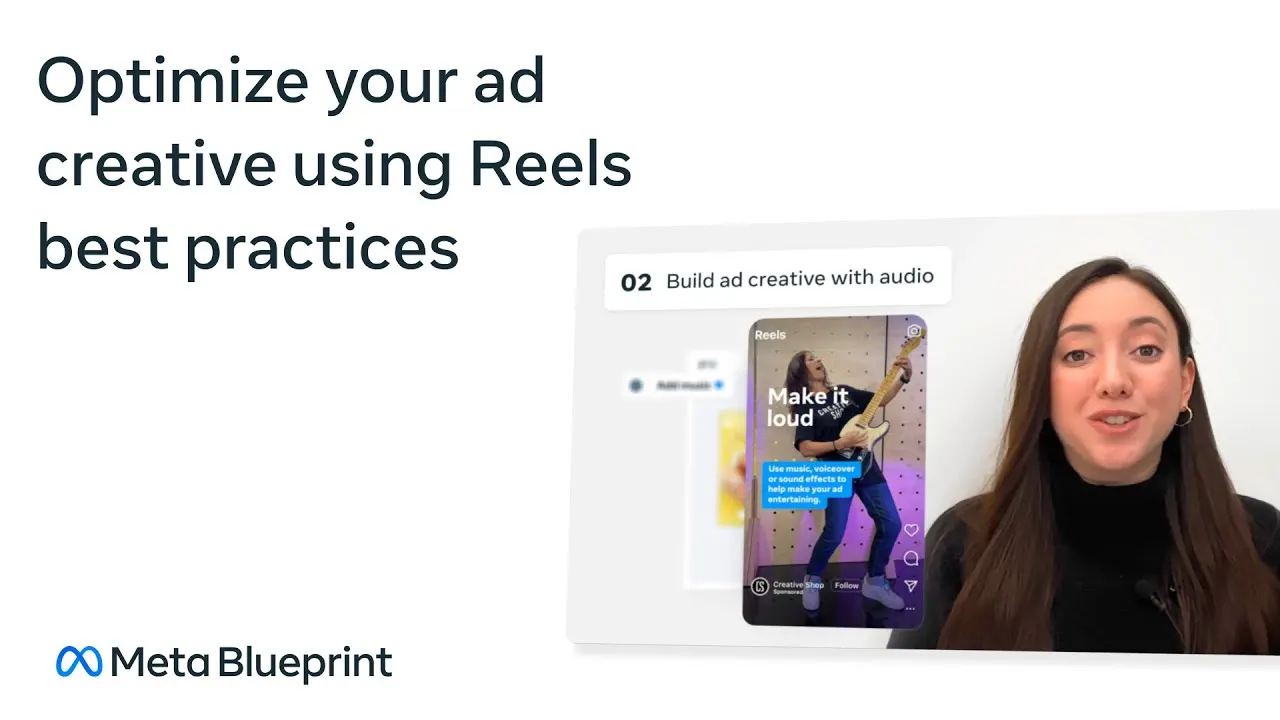
For RNJ Transport, a road freight company in Lithuania, we made 4 promo videos for YouTube in English and Lithuanian, of 60 and 56 seconds, and 7 YouTube Shorts. In the video below, Meta for Business shows the basics of a Reels ad: full-screen vertical video, sound and the safe zone.
Ad variants that change the angle
Make ad variants that change the argument, not only the words. Each variant tests a different reason to buy: the pain, the result, the proof, an objection or a comparison. AI makes variants cheap to produce, so the risk is ten versions of one idea. Test angles against each other, then make new versions of the angle that wins.
A simple test: if two variants would win or lose for the same reason, they are one variant. “Arrives in 48 hours” and “Fast delivery you can count on” test one angle. “Arrives in 48 hours” and “Free returns for 30 days” test two.
Before the variants, we write the buyer, the reason to buy and 3 to 5 angles in a brief. Ad images follow the same rule, and our guide to AI product photos and ads covers them.
AI labels on video ads
Meta labels ads made or significantly edited with its own generative AI tools as “AI info”. Since 1 June 2026, Meta also detects and labels ads made with third-party AI tools, through industry signals. In the EU, AI Act Article 50 applies since 2 August 2026 and asks you to disclose deep fakes, such as a realistic AI person.
Meta puts the label in “About this ad”, in the three-dot menu of every ad. When its tools add an AI-generated photorealistic human to an ad, the label appears next to “Sponsored” instead, where every viewer sees it. Meta says this can vary by region because of local law.
Under AI Act Article 50(4), a deployer who makes a deep fake must disclose that the content is AI-made. For clearly creative or fictional work, you disclose that the AI content exists in a way that does not disturb the work. Article 50(5) asks for the information at the latest at the first exposure.
Article 50(2) puts a second duty on the makers of AI tools: they mark their output as AI-made in a machine-readable way. Tools that were on the market before 2 August 2026 have until 2 December 2026. This page is not legal advice, so check your own ads with your lawyer.
Common questions
What is an AI video ad?
An AI video ad is a paid video ad where AI tools make some or all of the picture, the voice or the music. It runs on social media, YouTube or TV. A person chooses the offer, the angle and the claims, and approves the final file before it runs.
How long should an AI video ad be?
Match the length to the placement. A YouTube bumper is 6 seconds, Google recommends about 15 seconds for skippable in-stream ads, and 10 to 30 seconds for Shorts ads that ask for an action. On every placement, show and name the product in the first 5 seconds.
Which aspect ratio should we use for AI video ads?
Start with 9:16 vertical, at 1080x1920 pixels or more, for Instagram Reels, TikTok and YouTube Shorts. Make a 16:9 version at 1920x1080 for YouTube in-stream and bumper ads. Keep text and logos inside the safe zone of each placement.
Do we have to label AI video ads?
Meta labels ads it detects as made or edited with AI as “AI info”. In the EU, AI Act Article 50 asks you to disclose deep fakes, such as a realistic AI person or scene, since 2 August 2026. Check your own case with your lawyer.
Can AI make a TV commercial?
Yes. In June 2025, a 30-second ad for Kalshi, made entirely with AI clips, aired during Game 3 of the NBA Finals. Its creator told NPR that he used Google’s Veo 3 and needed two days. Any AI commercial still needs a person to check every claim.
How many ad variants should we test?
Test angles, not wording. Write 3 to 5 angles in the brief, such as pain, result, proof, objection and comparison, and make one ad per angle. When one angle wins, make new versions of it with different hooks and proof.
Can you make the same AI video ad in English and Spanish?
Yes. We write each language version from the brief, so the voice, the captions and the on-screen text read natively. For RNJ Transport, we made YouTube promo videos and Shorts in English and Lithuanian.
Sources and checks (10)
- Google Ads Help: about the ABCDs of effective video ads
- Google Ads Help: about video ad formats (checked November 2026)
- Google Ads Help: your guide to YouTube Shorts ads (checked November 2026)
- Google Ads Help: video ads specs and format requirements (checked November 2026)
- Meta ads guide: Instagram Reels video ads (checked November 2026)
- TikTok Ads Manager help: video ads specifications (checked November 2026)
- Meta: expanding GenAI transparency for Meta’s ads products (updated 1 June 2026)
- European Commission, AI Act Service Desk: Article 50, transparency obligations
- European Commission, AI Act Service Desk: implementation timeline (checked November 2026)
- NPR: an AI video ad is making a splash (23 June 2025)